Is It Absurd to Believe in Ghosts?
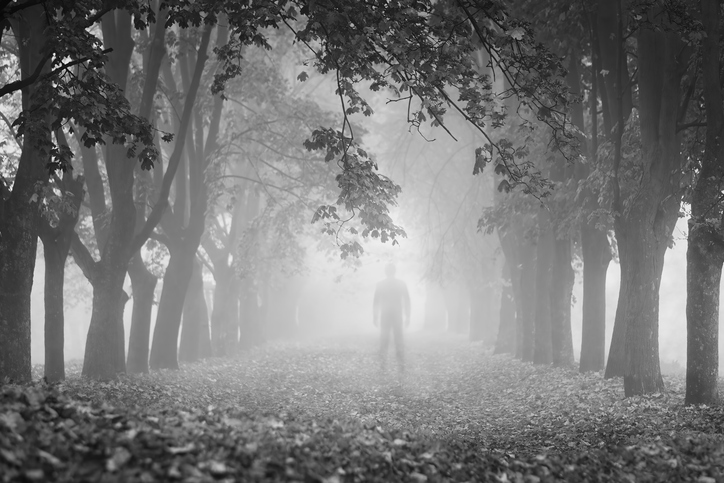
When people learn that I write books about the paranormal, I usually receive one of three responses. Either they politely change the subject, they look at me as if I might be out of my mind (and then change the subject), or they want to know more. Among those in this latter category, they not only want to know more, but are often anxious to regale me with their own stories, most of which have to do with recently departed loved ones. I happily oblige them, of course, because I know their story is important to them and has had a profound effect upon their life.
You see, when someone believes in things like ghosts, it is a sign that they have expanded their world view—often against their own freewill—beyond what is comfortable for most people. It has given them the sudden ability to see the bigger picture, consider other possibilities, and even feel free to challenge many of their own long-held beliefs. They have, in effect, peeked behind the curtain of this thing we call reality and have discovered that there is much more going on than they ever imagined possible.
But isn't believing in ghosts foolish? I mean, aren't ghosts just a bunch of hokum designed to scare children, entertain adolescents, and bemuse adults? Certainly, Hollywood has done a good job convincing us that while ghosts may make for scary and fun entertainment, they remain the stuff of legend; something interesting to consider but not something to be taken seriously. I wonder, though, if in assuming this position, we aren't missing out on something that could have immense ramifications for our personal lives.
Unlike Santa Claus or the tooth fairy, ghosts are not just something we imagine to exist. They are a part of our shared human experience and one that transcends culture, geography, religious beliefs and even time itself. People have reported seeing ghosts throughout recorded history (and, we can assume, even long before then). In fact, according to a 2021 YouGov poll, a whopping 41 percent of the adult population of the United States believes in ghosts, with 20 percent believing they have either personally seen one or felt that they were in the presence of one. That's over 110 million people—with some 54 million of these believing they have personally seen a ghost. These are not insignificant numbers and, I suspect, they compare favorably when compared to the number of adults who are convinced of the existence of either Santa Claus or the tooth fairy. As such, the assumption that a belief in ghosts is a fringe belief or something held to by only the most superstitious and naive people is clearly unsubstantiated.
Unfortunately, ghosts are something that cannot be easily tested. Thousands of photographs, hundreds of videotape and audio files, and the eyewitness accounts of millions of sober, mature, and often highly intelligent people is not enough to demonstrate to sciences' satisfaction that ghosts are, in fact, a part of our reality that exists just beyond our current means of perceiving them. As a result, it will always be easy to dismiss the phenomena entirely as "pseudo-science" at best, or pure nonsense at worst.
If that's the case, however, then what is science's explanation for what people are seeing? While hoaxers have had fun with the paranormal for years and some witnesses are prone to exaggeration, wishful thinking, or are victims of their own fearful imagination, it would be presumptuous to dismiss every scrap of evidence as worthless. This is especially the case with those individuals who didn't believe in ghosts prior to seeing one, or to those who were never expecting to encounter one, or for the many videos and photos that can't be explained away as mere hoaxes, tricks of light and shadow, or photo anomalies. People are seeing—or, at least experiencing—"something" out there. Science isn't obligated to accept such evidence as "proof," of course, but it must at very least be open to examining the evidence in an objective and fair manner. Otherwise, science isn't doing its job or even being true to its own creed of following the evidence wherever it leads regardless of where that final destination may be.
But let's get back to our main point: is it absurd or foolish to believe in ghosts? To answer that, it will first be necessary to define what we mean by a "ghost." Are we talking about angels and demons, interdimensional beings, cloaked extraterrestrials, residual manifestations, disembodied spirits or what? While I suspect most people maintain at least one and, in some cases, maybe even all of the above possibilities as a definition, to keep it simple I suggest a "ghost" be defined as the disembodied personality of a deceased person that is capable of interacting—at least to some degree—with the physical world. Not only does this "personality" have the ability to make itself known—either audibly or visually—but it appears to be somewhat aware of its surroundings, and even possesses a degree of free will. How it came to be in such a state or why it remains essentially "locked" into a specific time and location is a subject for another time, but suffice is to say that what we are dealing with here is effectively a fellow human being who was once a thing of flesh and bone like ourselves but now exists on another plane of reality entirely. While they are often perceived by most people as frightening, they are rarely being so on purpose. It is a result of our own fears about the unknown that makes them "scary" rather than a reflection of these entities' basic characteristics.
Naturally, the materialist will object to this definition by pointing out that once the brain dies, the personality it manifested during life—along with all its likes and dislikes, traumas, experiences, proclivities and even eccentricities—vanish with it—a perspective that science has generally held to over the last two centuries. However, this assumption has come under scrutiny over the last few decades as rapid advances in neuroscience has repeatedly shown that while science can map the brain in tremendous detail, it cannot seem to find the source of personality (or what it known more broadly as consciousness). Scientists can see where memory is stored and stimulate areas of the brain to induce various feelings and sensations, but in terms of determining where we get our sense of self-awareness from, it remains one of the enduring mysteries of neuroscience. While most dismiss this problem by assuming it is only a matter of time until a breakthrough discovery will be made that will clear all of this up, there is a small but growing cadre of scientists who challenge such an assumption and question whether consciousness originates within the brain at all. Some even openly wonder whether instead of the brain serving as a kind of transmitter of consciousness—and, with it, personality—it is in fact a receiver of consciousness. In essence, the brain may act in much the same way a radio receiver does when it picks up radio signals, but instead of manifesting music and talk shows, it instead "picks up" consciousness from the universe and manifests what it detects into the form of a unique personality.
If that's the case, however, then that suggests that the elements that make up our basic personality exists outside ourselves and is simply using our brain as a mechanism to interact within the world of physicality. As such, once that brain is no longer functional, what's to say the personality that used that brain purely to operate in the physical realm doesn't return to its source in a disembodied form? While this is largely conjectural, if true it would explain the phenomena of ghosts quite nicely. A ghost, then, would simply be a personality that has detached from its body and now exists in a sort of ethereal state of being—but one capable of still interacting with the physical world under proper circumstances.
Further, it is a well-known axiom of science that energy can be neither created or destroyed but that it is simply transformed, and what are we if not manifestations of energy trapped within an earthen vessel of flesh and bone? Perhaps ghosts, then, are nothing more than that energy finally being released from its fleshly container that is trying to let us know that they live on, albeit in another context.
Naturally, this brings up the question that if this is the case, why can't we perceive these "personality clusters" on a regular basis? Is it because we lack the sensory instruments necessary to perceive them or could it be the case that the entities themselves are limited in their capacity to make themselves known for various reasons? The answer to that must remain a mystery for now and, of course, let's not forget that there are individuals out there who do claim to be able to perceive these entities. We call them mediums, psychics, or sensitives, but unfortunately, since the entire issue of mediumship has been a source for much chicanery and outright fraud over the years, science naturally rejects the claims of such individuals out of hand. (This despite the fact that there are some mediums who have been carefully tested under laboratory conditions—see the work of University of Arizona researcher Dr. Gary Schwartz—and have demonstrated the remarkable ability to consistently obtain obscure information from these entities that can be collaborated and authenticated. As such, one would be ill-advised to discount the possibility that there are bonafide mediums out there for in doing so one may be negating a very valuable asset in determining the truth behind the phenomena.)
So is it absurd to believe in ghosts? No, it is not. It is certainly not absurd if one has actually taken the time to carefully study the many audio and visual recording for their existence and find themselves unable to debunk the majority of what has been captured. It's also not absurd if one believes that there is more to our existence than what this short life offers and that we continue on even after death. Additionally, it's not absurd if one is open to the idea that there is more to reality than what can be perceived with our own senses and are humble enough to admit that we don’t have all the answers. And, finally, one is not foolish if they have had a personal encounter with a ghost that shook them to their core and perhaps even forced them to reconsider their entire worldview considering what they have experienced for themselves.
The question of whether ghosts are real or not may never be finally settled to science's satisfaction. Unfortunately, this leaves the science community with no choice but to dismiss every shred of evidence as complete nonsense. It also forces it to explain why so many reasonable people are experiencing what they can only consider to be ghostly manifestations. While there are those who have made it their life mission to perform this very task, I suspect it is an uphill proposition, especially in light of the fact that when it comes to eternity, a part of us seems to sense that the show must go on, if not on this plane of existence, then in the next. Of course, the materialist response to this is to suggest that such a belief is merely a byproduct of humanities' deeply ingrained fear of death and the quest for immortality, but the fact that one wishes to exist beyond this mortal state is not proof that such is an impossibility. After all, most, if not all, of the things we desire in life—fame, wealth, good health, friendship, the desire to love and be loved, etc.—genuinely do exist, so what is the logic behind leaving the desire for immortality off the list?
In the end, perhaps the question that really needs to be asked is whether or not it is possible that there exists within this world things that are beyond our ability to perceive. How you answer that will determine whether you can allow for things like ghosts to potentially inhabit your world. As for me, I find I have no trouble allowing them into my reality, for in doing so I am merely making way for the many other mysteries of the universe to reveal themselves to me in their own sweet time.

About J. Allan Danelek
Related Products

is subject to certain Terms and Conditions