A Quick Overview of Thelemic Holidays
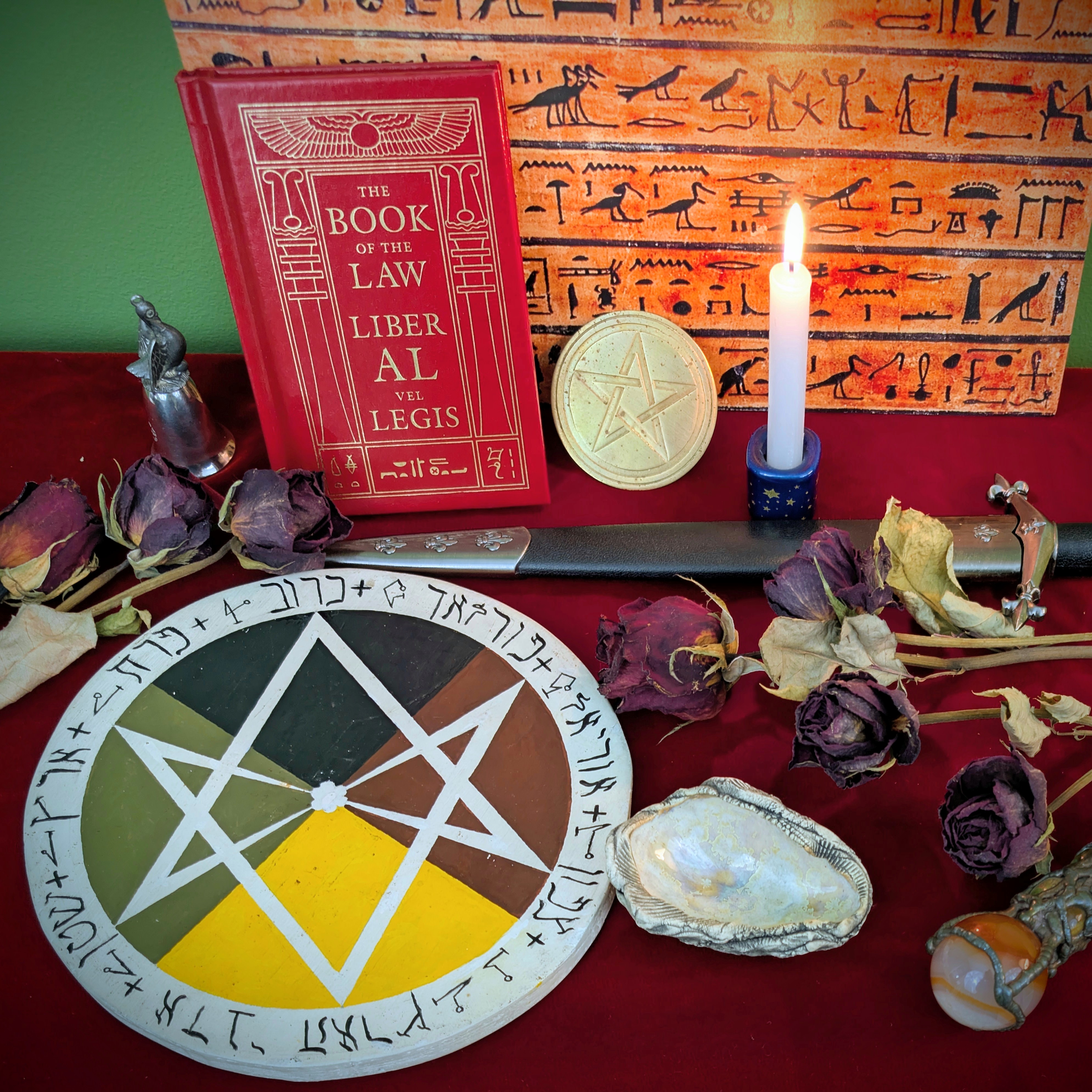
You step inside a room transformed with the dancing glow of candles, perfumed by swirling incense, and adorned with the emblems of the season. Sights, sounds, and symbols awaken your imagination. Ritual chanting and prayer take you deeper into the moment and stir some distant yet familiar feelings. It's easy to feel the magick of a holiday surrounded by symbols and sensations that connect you to something deeper. Stepping into a celebration is your invitation to step outside of the mundane. It's an opportunity to connect to something beyond yourself. How do people celebrate the times of the year and the times of our lives? This article provides a quick overview of the holy days, also known as holidays, found in the magical tradition of Thelema.
Many witches, pagans, occultists, and magical practitioners find great meaning and value in celebrating holidays throughout the year. These holidays are as diverse as the people who observe them. A common framework people use for these recurring celebrations is the Wheel of Year. The Wheel of the Year is an annual cycle of eight seasonal festivals popularized by Gerald Gardner, founder of Gardnerian Wicca. Many take this format and expand upon it by plugging in their celebrations or traditions. Although this format is very common, not every magical tradition fits into the Wheel of the Year format, and it's valuable to consider things that do not. Exploring this diversity offers new inspiration and a fresh perspective to reinvigorate your own celebrations.
What some people may not know is that many of the seasonal cycle of celebrations found in the Wheel of Year pre-date their popularization by Gerald Gardner. One of Gerald Gardner's influences was the magical tradition of Thelema. Thelema is a religion, philosophy, or system of mysticism that emerged in the early 1900s thanks to the work of notable historic figures that include Aleister Crowley and Rose Edith Kelly. Thelema's famous tenet, "Do what thou wilt shall be the whole of the Law,"1 is a call on everyone to discover their unique inner nature, purpose, or Will in the grand scheme of things, and focus their energies exclusively to that end. The heart of this tradition is radical self-knowledge and self-acceptance. It's a celebration of the fact we are divine not despite our humanity, but because of it.
One of the fascinating and unique features of this tradition is its holidays. The original, core holidays in Thelema come from the central, sacred holy text called Liber AL vel Legis, commonly known as The Book of the Law. This holy text is one of many that make up the backbone of this religion. These holy texts are not meant to be read as unquestioned fact or followed in blind faith. They are invitations for doubt, introspection, and exploration. This includes the holidays that The Book of the Law calls for us to celebrate; what they mean and how you celebrate is up to you. Additionally, should you choose to celebrate the Thelemic holidays, you are not limited to only celebrating them. Many practitioners of Thelema, known as Thelemites, find it personally meaningful to weave all kinds of different things into their yearly celebrations. Modern practitioners have also invented their own Thelemic holidays in addition to those found in The Book of the Law.
I find it helpful to break the holidays into two categories: 1) the original holidays found in The Book of the Law and 2) holidays invented by modern practitioners. This diversity found amongst Thelemites is a sign of vitality, as Thelema is a living tradition that continues to grow and reflect the diversity of people who practice it. To that end, this article is not another piece of dogma meant to tell you what to celebrate or how to do it. It's simply a friendly exploration meant to inspire you on your own unique practice. Let's begin our journey by looking at the holidays found in The Book of the Law.
The section of The Book of the Law that outlines holidays includes those things to be celebrated annually, those to be celebrated at certain times of our life, and also a secret holiday. The passage is as follows:
34. But ye, o my people rise up and awake.
35. Let the rituals be rightly performed with joy and beauty.
36. There are rituals of the elements and feasts of the times.
37. A feast for the first night of the Prophet and his Bride.
38. A feast for the three days of the writing of the Book of the Law.
39. A feast for Tahuti and the child of the Prophet—secret, O Prophet!
40. A feast for the Supreme Ritual, and a feast for the Equinox of the Gods.
41. A feast for fire and a feast for water; a feast for life and a greater feast for death.
42. A feast every day in your hearts in the joy of my rapture.
43. A feast every night unto Nu, and the pleasure of uttermost delight.2
The Rituals of the Elements are observed when the Sun enters each cardinal sign of the zodiac: Aries, Cancer, Libra, and Capricorn. These are the points at the beginning of each season. Aleister Crowley explains that, "In particular the entry of the Sun into the cardinal signs of the elements at the Equinoxes and Solsticesare suitable for festivals."3 (Note that these Rituals of the Elements do not include the cross quarters, like the Wheel of the Year we discussed earlier does. This is just referring to equinoxes and solstices.)
In addition to these points, there are a few more holidays unique to the yearly celebrations in Thelema: 1) The First Night of the Prophet and His Bride, 2) The Three Days of the Writing of the Book of the Law, and 3) The Supreme Ritual and the Equinox of the Gods. These are the events involved with the reception of The Book of the Law. The first of these three commemorates Aleister Crowley's marriage on August 12, 1903, to Rose Edith Kelly, who on their honeymoon clairvoyantly contacted an entity foretelling the start of a New Aeon for humankind. The Supreme Ritual is a ceremony that Crowley performed under the direction of Rose and her spiritual contact. This ritual coincided with a cosmic shift in rulership known as the Equinox of the Gods. Both of these occurred March 20, 1904. This led to Crowley receiving The Book of the Law over three days in April 8, 9, and 10, 1904.
Just as we celebrate holidays through out the yearly cycle, The Book of the Law also calls for the celebration of moments throughout the cycle of our lives; the moments are birth, puberty, daily, and death. These are significant transitions in our life and worthy of recognition. A Feast for Life celebrates the birth of a child. The Feast for Fire and Feast for Water are celebrations of puberty, in recognition of a person taking a step out of childhood and into adulthood. A Feast for Death is a celebration upon the death of an individual. A Feast Every Day/Every Night are daily celebrations that can call attention to the movement of the sun from dawn, to noon, to dusk. (This dawn, noon, and dusk cycle is also reflected in our seasonal yearly cycle, as well as the cycle we experience throughout our entire lives from birth to death.) The Tahuti and the Child of the Prophet holiday is a secret holiday and something Crowley says very little about. In his commentaries his only note is that, "This particular feast is of a character suited only to initiates."4
There is no standard, universal way to celebrate these holidays, and there is a lot of room to get creative. For instance, for the Three Days of the Writing of The Book of the Law, you could at noon read the corresponding chapter that was communicated to Crowley at noon on that day in 1904. On the equinoxes you could draw an oracle—such as tarot cards, runes, bibliomancy, crystal gazing, or whatever is your preferred method— to pick up on the magical current of the next six months. The equinoxes are a perfect time to pick up on subtle energies, since the day and night are equal at these points in the year. In addition, the March equinox marks the beginning of the Thelemic new year, and the September equinox its midpoint, making these logical times to take stock and evaluate the course of the months to come. In my book, The Holy Year of Thelema: A Guide to the Ritual Calendar of Aleister Crowley's Tradition, I provide various celebratory suggestions, from easy things you can do on your own to more elaborate group rituals, including suggestions for altar work. This is a small mindful practice done at an altar. It is a personal practice of mine that others may find meaningful and wish to adopt for themself. This can be as simple as decorating an altar with the corresponding tarot card and other symbols of the season to use as a focus for meditation.
The following chart summarizes the holidays found in The Book of the Law:
| Holy Day | When Celebrated |
|---|---|
| Vernal Equinox | Northern Hemisphere: March 20th or 21st; Southern Hemisphere: September 22nd or 23rd |
| The Supreme Ritual and the Equinox of the Gods | March 20th |
| The Three Days of the Writing of the Book of the Law | April 8th, 9th, and 10th |
| Summer Solstice | Northern Hemisphere: June 20th or 21st; Southern Hemisphere: December 21st or 22nd |
| The First Night of the Prophet and His Bride | August 12th |
| Autumnal Equinox | Northern Hemisphere: September 22nd or 23rd; Southern Hemisphere: March 20th or 21st |
| Winter Solstice | Northern Hemisphere: December 21st or 22nd Southern Hemisphere: June 20th or 21st |
Life Cycle
| Holy Day | When Celebrated |
|---|---|
| Life | Birth |
| Fire/Water | Puberty |
| Every Day/Every Night | Daily |
| Death | Death |
Mystery of Mystery
| Holy Day | When Celebrated |
|---|---|
| Tahuti and the Child of the Prophet | Secret, O Prophet! |
In addition to the holidays found in The Book of the Law, modern Thelemites have invented a number of other celebrations and traditions. Here is a list of some of them:
- Crowleymas: October 12, an observation of Aleister Crowley's birthday.
- Aleister Crowley's Greater Feast: December 1, a commemoration of Crowley's death.
- The Holy Season: A list of texts meant to be read between March 19 and April 10, created by James Eshelman for his Second Order initiates of his Temple of Thelema, since modified and adapted by others.5
- Celebration of the Cross-Quarters: Although the Thelemic holidays are not the same as the Pagan Wheel of the Year, some Thelemites have created rituals and celebrations around the cross-quarters. The most notable is from Thelemic writer Dionysius Rogers, who created a Thelemic liturgy in his book Raise the Spell: An Arsenal of Thelemic Ceremony.6
- Gnostic Saint Feast Days: Some recognize the birth and death days of the Gnostic Saints in Ecclesia Gnostica Catholica (the ecclesiastical arm of O.T.O.).
These new expressions are a reminder that you can craft and personalize your own observations. Mindfully approaching your practice with a touch of creativity can be very fulfilling. May exploring the holy days of Thelema inspire you and your practice, whether daily, yearly, or through the arc of your life.
1. Liber AL vel Legis, The Book of the Law II:40.
2. Liber AL vel Legis, The Book of the Law II:34–43.
3. Aleister Crowley, Magical and Philosophical Commentaries on The Book of the Law, ed. John Symonds and Kenneth Grant (93 Publishing, 1974), 210.
4. Aleister Crowley, Magical and Philosophical Commentaries on The Book of the Law, ed. John Symonds and Kenneth Grant (93 Publishing, 1974), 211.
5. James A. Eshelman, "Thelemic Tephilah," Aumha, accessed April 30, 2025, https: //www.aumha.org/arcane/tephilah.htm.
6. M. Dionysius Rogers, Raise the Spell: An Arsenal of Thelemic Ceremony (Self-published, 2019).

About Maevius Lynn
Related Products

is subject to certain Terms and Conditions